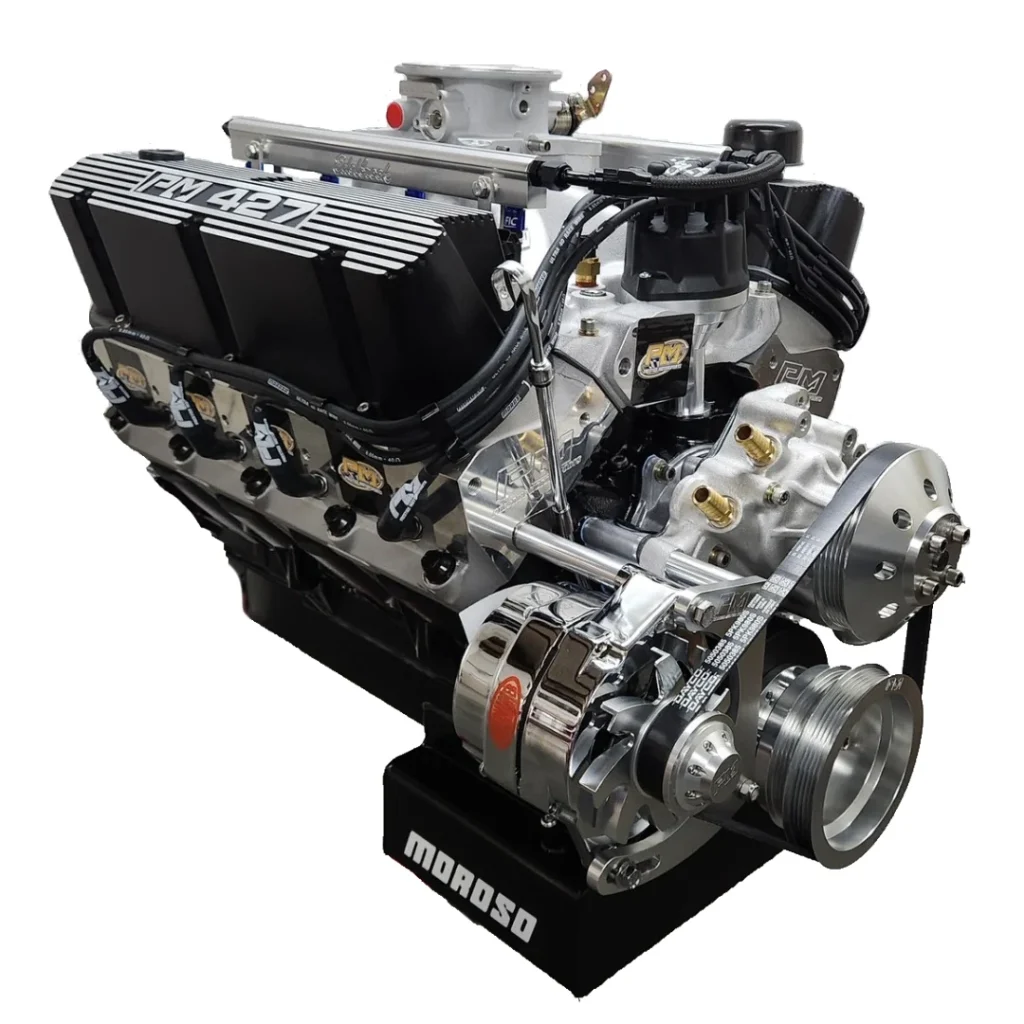
How Much Horsepower Does a 427 Engine Have?
If you’ve spent any time around muscle cars, hot rods, or performance forums, you’ve probably heard the same question over and over:
“How much horsepower does a 427 engine have?”
It sounds like a simple question. It isn’t.
A 427 engine can be a Ford, a Chevy, an LS, naturally aspirated, boosted, mild, wild, OEM-block, aftermarket-block — and depending on how it’s built, it might make 500 hp… or 1,400+ hp.
So the real answer is this:
A 427’s horsepower depends entirely on how it’s built and what it’s built for.
This guide breaks down real-world horsepower ranges, what affects them, and what Prestige Motorsports typically builds for Ford, Chevy, and LS customers.
The Short Answer — and the Real Answer
If you’re asking for a ballpark:
- A typical street-friendly 427 makes ~500–600 hp.
- A performance-oriented 427 can make 600–750 hp naturally aspirated.
- A boosted 427 can exceed 1,000 hp.
But here’s the truth…
There is no single horsepower number for a 427 engine, because the displacement doesn’t dictate power. The parts do.
Whether it’s a Ford 427, Chevy 427, or LS-based 427, the final horsepower depends on:
- Block strength (OEM vs aftermarket)
- Cylinder heads
- Camshaft profile
- Compression ratio
- Fuel system (carb vs EFI)
- Intended use
- Supporting systems (cooling, exhaust, fuel delivery)
- Rocker arms and valve springs for high-RPM stability
- Whether you’re running boost
So let’s break these down.
Typical Horsepower Ranges by Platform
Ford 427 Horsepower
Typical NA horsepower ranges:
- 500 hp (OEM block, as-cast heads)
- 520 hp (OEM block, CNC-ported heads)
- 575–600 hp (Aftermarket Dart SHP block, CNC heads)
Why such a wide range?
Because airflow, compression, and valvetrain components like rocker arms and valve springs dramatically change the output and usable RPM range.
Ford owners tend to prefer fully custom setups with premium components, which is why these builds often land at the higher end.
Chevy 427 Horsepower
Prestige’s Chevy 427 small-block builds usually fall into:
- 530 hp
- 575 hp
- 600+ hp
Chevy and LS buyers often start with more budget-focused goals, but the same rules apply:
Better heads + better cam + stronger block = more power.
LS 427 Horsepower
LS architecture breathes extremely well, so these engines typically make a bit more power naturally.
- 570–600+ hp NA is common
- Boosted LS 427s can exceed 1,000+ hp easily
What Really Determines a 427’s Horsepower?
It’s not the cubic inches that matter.
It’s the combination of parts.
Here are the biggest horsepower influencers:
Cylinder Heads (The #1 Difference-Maker)
The jump from as-cast to CNC-ported heads can be worth 20+ horsepower alone — and often much more depending on cam and compression.
Prestige’s rule of thumb:
- 500 hp = as-cast head
- 520+ hp = CNC-ported head
- 575+ hp = aftermarket block + CNC heads
If you want the big numbers, airflow is what gets you there.
Camshaft Profile
The cam determines:
- Idle quality
- Torque curve
- Peak horsepower
- Vacuum (needed for power brakes)
Prestige has proprietary custom grinds from Comp Cams for each horsepower level. But customers can spec a custom profile if they want something specific — mild, lumpy, aggressive, high-RPM, you name it.
Compression Ratio
Most of Prestige’s naturally aspirated 427 engines run:
- 10.5:1 compression
Boosted builds drop down (often 9:1) for detonation resistance.
Rocker Arms & Valve Springs
The valvetrain keeps the power alive at higher RPM.
- Strong rocker arms prevent flex or failure
- Upgraded valve springs allow sustained 7,000–8,000 RPM operation
- Essential for autocross, road racing, and high-RPM strip builds
If you want power and reliability, this is one place you never cut corners.
Block Strength
Simply put:
- OEM blocks top out around ~500 hp reliably
- Dart/aftermarket blocks support 600+ hp NA
- Boosted 427s require an aftermarket block
Prestige sells both iron and aluminum blocks depending on budget and goals, with Dart SHP being their go-to.
How Intended Use Changes Horsepower Targets
Street / Strip (Most Common)
- 500 hp is the “magic number” for most drivers
- Tons of torque
- Reliable, fun, and easy to live with
Drag Racing
- Often boosted
- 800–1,400+ hp possible
- Requires major supporting systems (fuel, cooling, transmission)
Autocross / Road Race
- Need high-RPM strength
- Upgraded rocker arms, valve springs, and oiling systems
- Higher-revving cam profiles
Marine / Endurance
- Torque > peak hp
- Long sustained load requires different cam + cooling strategy
Dyno Horsepower vs Real-World Horsepower
Engine dynos read higher than the wheels because driveline losses eat power.
Rule of thumb:
- Engine dyno: 500 hp → ~400 whp
If a customer wants 500 at the wheels, Prestige builds ~575 hp at the crank.
Torque Matters Just as Much
Prestige aims for torque numbers equal to horsepower:
- 500 hp → ~500 lb-ft
- Flat torque curve from 2,000–4,000 RPM
That torque-on-demand feel is what makes their engines so fun in real driving.
Common Misconceptions About 427 Horsepower
Misconception #1: A 427 should make 700 hp “easy.”
No — not if you want it to last.
Prestige builds for durability, not internet bragging rights.
Misconception #2: Stock parts will work fine with a new engine.
They won’t.
Supporting systems matter:
- Fuel system
- Cooling system
- Transmission
- ECU
- Exhaust
Skipping these creates failures, overheating, and blown transmissions.
Prestige only uses proven vendors (Wizard Cooling, Aeromotive, Tremec, Gearstar) to ensure reliability.
When You Need More Than a 427 Can Give
If the customer wants more power than a safe 427 can produce, Prestige may recommend:
- A larger displacement
- A high-compression NA build
- A supercharger, turbo, or nitrous setup
- Or stepping up to a different platform entirely
They’ve built 427s making over 1,400 hp — but that’s not typical or budget-friendly.
Why a Prestige-Built 427 Stands Apart
Customization
- EFI or carb
- Top-end options
- Valve covers, pans, accessories
- Colors, finishes, and cosmetic choices
- Power level tailored to goals
Documentation
Every engine includes:
- Dyno video
- Dyno sheet
- Build documentation
- Long-term support
Support
Prestige customers are “family” — they can call back 20 years later for help, and Prestige will still have their build file.
The Best First Step Toward Your 427 Build
If you’re trying to choose the right 427 engine — Ford, Chevy, or LS — the best starting point is simple:
Schedule a consultation and tell us your goals.
Whether you want a street-friendly 500 hp cruiser, a torque-rich autocross engine, or a boosted monster making four-digit power, Prestige will help you choose the right block, heads, cam, compression, and supporting components.
Every 427 build starts with the same question:
“What do you want this engine to do?”
From there, we build the power to match.