A Cooling System Shouldn’t Be an Afterthought
We see it more often than you might expect.
Someone builds a beautiful performance car. They’ve put serious thought into the engine, transmission, accessory drive, and nearly every other part of the vehicle.
Then they get to the cooling system.
They buy a radiator. They find a fan that looks like it should move enough air. They install everything and discover the engine doesn’t stay as cool as expected.
Sometimes the problem isn’t that any one component is obviously wrong. It’s that nobody looked at the cooling system as a complete package before choosing the parts.
At Prestige Motorsports, that’s how we approach it.
We’re not designing every radiator and fan combination from scratch. We’re selecting proven, well-engineered components that we know work efficiently together, then making sure that package fits the particular vehicle, engine, accessory drive, and available space.
And what we’d choose today isn’t necessarily what we would have chosen 10 or 15 years ago.
Cooling technology has come a long way.
What Makes a High-Performance Cooling System Work?
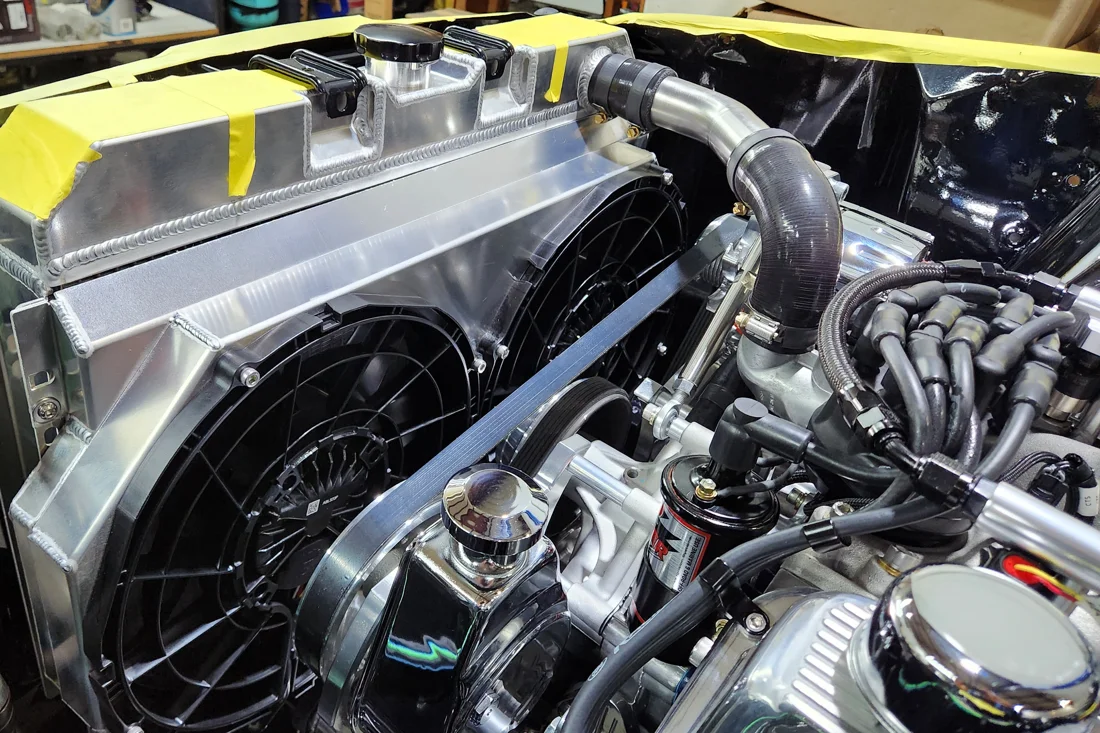
A properly designed cooling system starts with several key components:
- Radiator
- Cooling fan or fans
- Fan shroud
- Water pump
- Thermostat
- Expansion reservoir
- Fan controls and supporting electrical system
But choosing the right engine cooling system components isn’t simply a matter of finding the best version of each one individually.
They have to work together.
A more efficient radiator core, for example, can have more tubes and fins per inch. That gives us greater cooling capacity, but it also creates more restriction for the air trying to pass through the radiator.
That means we need a fan capable of pulling enough air through that restriction.
The water pump, thermostat, and fan controls also need to complement one another. And before any of those parts are selected, we need to know how much physical room we actually have between the engine and cooling system.
That’s why we think about the entire package from the beginning.
Modern Radiators Have Changed the “Bigger Is Better” Rule
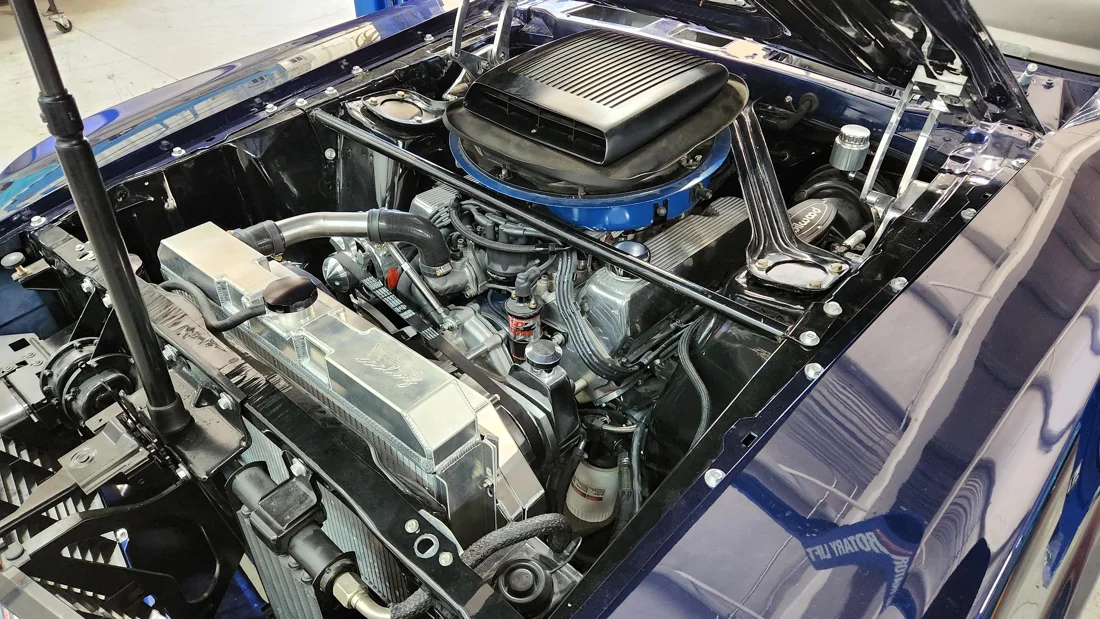
For a long time, one of the simplest ways to improve cooling was to install a bigger radiator.
Older radiators and fans weren’t as efficient as the products available today, so additional surface area gave you more capacity to dissipate heat.
You can see that thinking in classic cars.
Take a 1965 Mustang compared with a 1969 Mustang. The earlier car typically had a much smaller radiator. It wasn’t unusual for builders to open up or replace the core support so they could fit a larger radiator.
With today’s more efficient radiators and fans, that isn’t always necessary.
We still want adequate cooling capacity, of course. But modern technology can allow us to accomplish more with less physical radiator capacity than we could years ago.
Does a Performance Radiator Need More Rows?
This is also why we don’t select a performance radiator simply by looking for the greatest number of rows.
You’ll see plenty of radiators marketed around being a three-row or four-row design, which can create the impression that more rows automatically mean greater cooling capacity.
That’s not necessarily the case.
We typically use a properly engineered two-core radiator and rely on the manufacturer to determine factors such as fins per inch and cooling capacity.
So if you’re comparing a 2-row vs. 3-row radiator, don’t assume the three-row option is automatically better. Core design and overall efficiency matter more than a number on the product description.
Why We Use Wizard Cooling
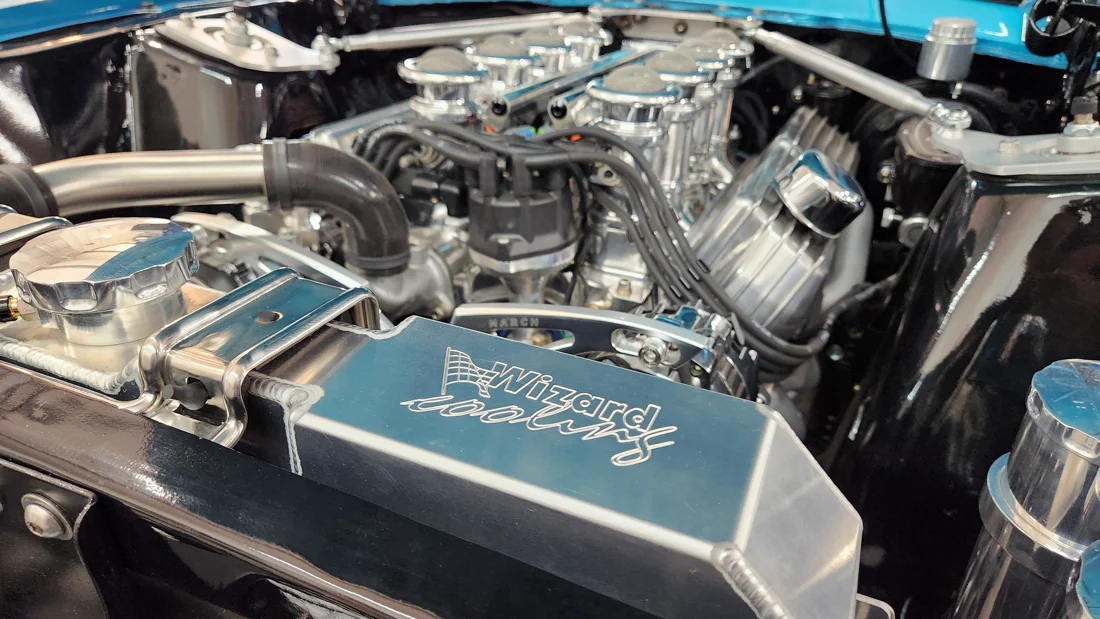
The manufacturer behind those components matters too.
Wizard Cooling has been our preferred cooling-system supplier for roughly five to seven years because they approach cooling much the same way we approach engines.
We personalize an engine package around the customer’s vehicle and goals. Wizard can do the same thing with the cooling system.
Rather than simply selling us a radiator off the shelf, their team understands the technical side of radiator efficiency and can help us modify or custom-design a package when an application requires it.
Depending on the vehicle, that can go well beyond the radiator itself.
We can get the radiator, fans, and temperature controls as an engineered package. If the car has air conditioning, Wizard can provide a pre-mounted A/C condenser. For a supercharged application, the modular package can also incorporate a heat exchanger and reservoir for the supercharger cooling system.
The components are already designed to work together and fit the vehicle.
That makes our job easier, but more importantly, it gives us a cooling package we can trust behind the engines we build.
Brushless Radiator Fans Have Changed the Game
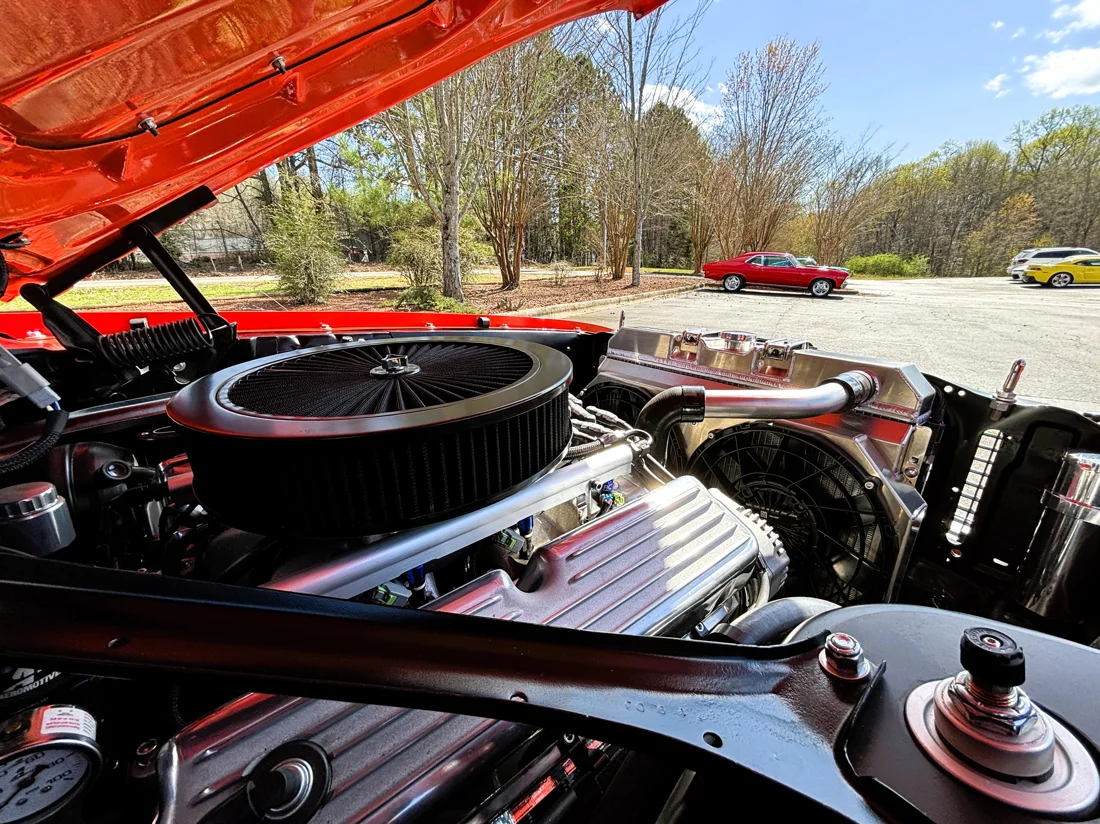
If we had to identify the biggest change in cooling-system technology over the past five to seven years, it would probably be the brushless radiator fan.
Modern brushless, pulse-width-controlled fans are considerably more efficient than the traditional fans we relied on years ago.
More available fan power means we can use larger, wider blades capable of moving more air through the radiator. That additional airflow has also helped make today’s more efficient radiator cores possible.
Remember, adding more tubes and fins per inch increases cooling capacity, but it also makes the radiator more restrictive to airflow.
A powerful fan allows us to pull air through that denser core effectively.
Brushless fans also don’t necessarily operate at full speed whenever they’re on. They can gradually ramp up and down depending on demand. That reduces the sudden electrical load associated with a conventional brushed fan switching on at full power, while also reducing the amount of time the fan needs to operate at maximum output.
The result is a more efficient system and potentially longer trouble-free fan life.
Why Prestige Uses SPAL Brushless Fans
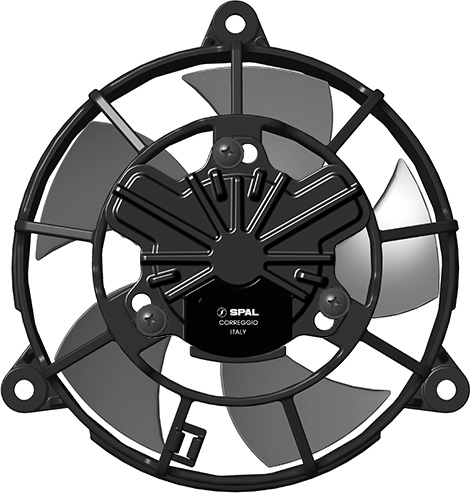
There’s another reason we’re particular about fans: advertised CFM doesn’t always tell you what you think it does.
A fan hanging in open air can move plenty of air.
Put a radiator in front of it and the situation changes.
The radiator creates restriction, or static pressure. What matters to us is how much air that fan can actually move when it’s pulling through that restriction.
That’s one reason we use SPAL brushless fans exclusively.
SPAL provides airflow information with static pressure applied, allowing us to evaluate how the fan performs under conditions that more closely resemble what it will encounter behind a radiator.
That’s considerably more useful to us than simply seeing a large CFM number on a box.
We’ve heard claims of inexpensive fans moving 3,000 CFM, for example. One basic reality check is the electrical demand. Moving that much air requires an appropriately sized motor and fan blade, which in turn requires amperage. If a supposedly enormous fan operates happily through a 15-amp fuse, that’s reason to question whether it is really moving the amount of air being advertised.
When it comes to cooling a performance engine, we want more than a number.
We want to know the fan can actually do the job.
A High-Flow Water Pump Is Only Part of the Equation
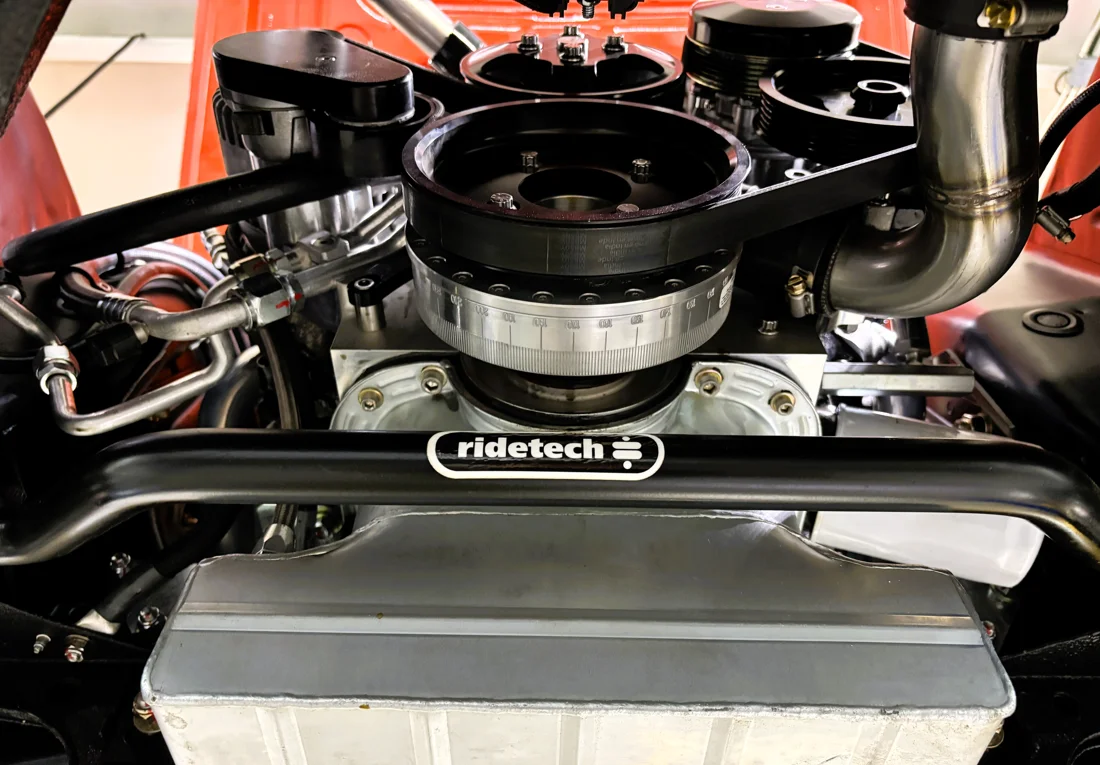
Coolant has to move efficiently too.
When we’re selecting a water pump independently, we’re generally looking for a high-flow water pump with high-volume capability.
But the pump itself isn’t the only consideration.
How fast we’re turning it matters.
Many of the accessory-drive systems we use overdrive the water pump by roughly 10 to 15 percent. That helps maintain good coolant flow even when the engine is operating at lower speeds.
This is another example of why cooling-system components can’t be selected in isolation.
A high-flow pump, the pulley ratio that drives it, the thermostat, and the rest of the cooling system all need to complement one another.
Your Accessory Drive Can Affect Your Cooling System
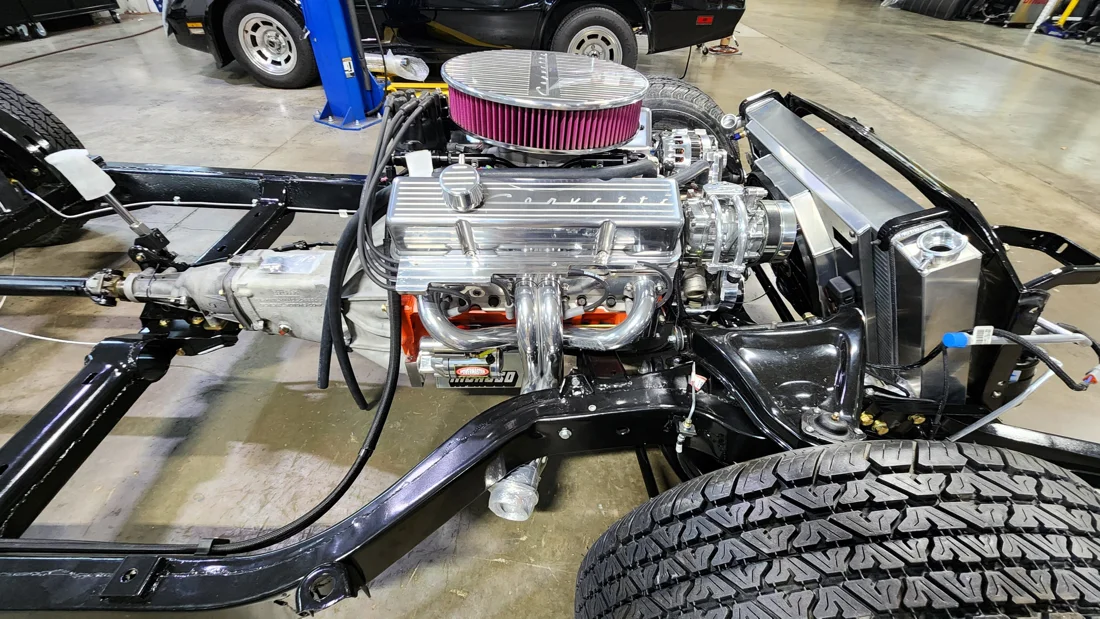
There’s another reason we pay close attention to the accessory drive that has nothing to do with how the pulleys look.
Space.
We generally recommend compact pulley systems with short-style water pumps. Along with providing the high-flow pump and quality accessories we want, the compact design gives us more room between the front of the engine and the radiator.
That clearance can make a major difference in the cooling package we’re able to install.
If the accessory drive wasn’t considered until everything else was already positioned, you can end up with so little room that you’re forced to compromise.
We’ve seen people put electric fans on the front of the radiator as pushers because they don’t have room behind it. Others eliminate the shroud and attach a fan directly to the radiator core.
Those aren’t compromises we want to make.
Choosing the accessory drive with the cooling system in mind gives us the room to install the radiator, shroud, and fan package properly in the first place.
Why We Use High-Flow Thermostats
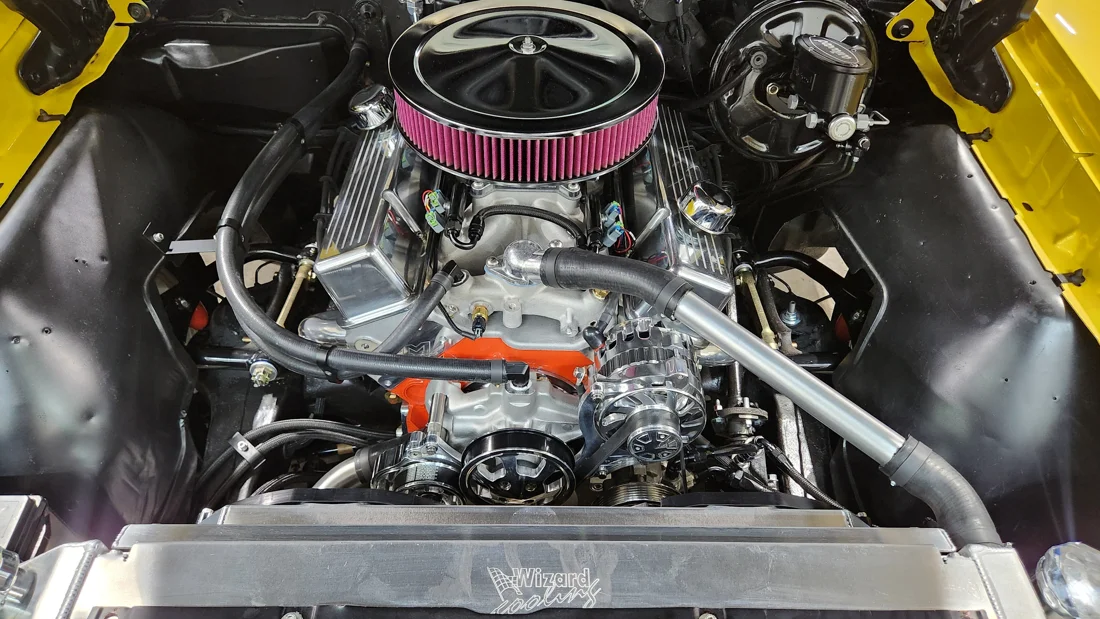
The same systems approach applies to the thermostat.
For the performance street cars we typically build, we’re generally using a thermostat in the 185- to 195-degree range. More importantly, we tend to use a high-flow thermostat.
If we’re moving more coolant with a high-flow water pump and increasing pump speed through the accessory drive, we want the thermostat to support that flow rather than becoming an unnecessary restriction.
We also want the thermostat and electric fans working together.
Ideally, once the engine reaches normal operating temperature, the thermostat remains open while the fans cycle as necessary to regulate temperature. We generally want the fans coming on after the thermostat has opened rather than having the thermostat continually opening and closing as the vehicle travels down the road.
It’s another small example of components being selected and configured as a system rather than independently.
Don’t Forget the Coolant Expansion Tank
One of the simplest components is also one we consider essential: the coolant expansion tank.
As coolant heats up, it expands. The reservoir needs enough capacity to accept that additional coolant and then allow the system to draw it back in as the coolant contracts.
For many of our applications, somewhere around 16 to 20 ounces can be a reasonable starting point, although actual requirements depend on the engine and cooling system.
The tank also needs to be vented rather than completely sealed.
We’ve used Billet Specialties reservoirs on many builds, but Wizard Cooling can now integrate the reservoir into the radiator package. That’s a particularly clean solution when we don’t want a separate tank mounted elsewhere in the engine compartment.
Other builds may deliberately feature an external reservoir as part of the overall engine-bay design.
Either approach can work.
What matters is that the system has an adequately sized, properly functioning reservoir.
What Coolant Do We Use?
With all the technology that has changed over the years, our coolant choice is remarkably conventional.
We typically use standard green glycol coolant in a 50/50 mixture.
There are waterless coolants and additives marketed around reducing operating temperatures, and some of those products may have benefits. But our approach is to build a cooling system that doesn’t need an additive to compensate for inadequate cooling capacity.
If the radiator, fans, water pump, thermostat, and rest of the system are properly selected and working efficiently together, we don’t see a reason to complicate the coolant choice.
Sometimes simple works just fine.
Do You Need Custom Radiator Hoses?
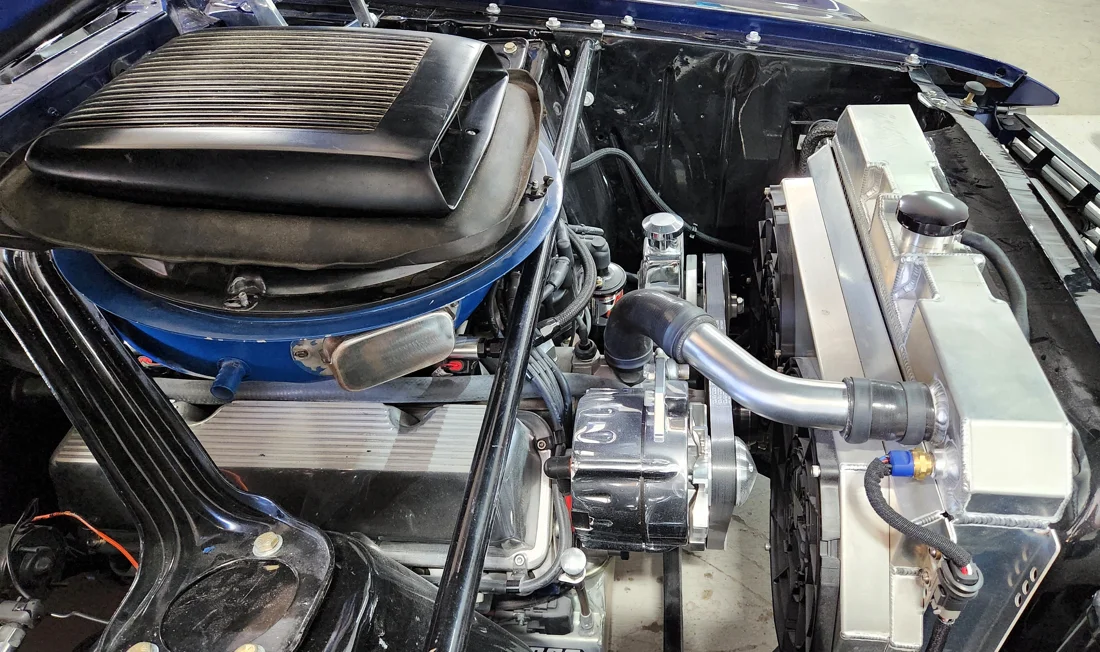
Not necessarily.
A conventional upper and lower rubber radiator hose with standard clamps can work perfectly well.
On many Prestige builds, however, we fabricate coolant tubes from mandrel-bent stainless steel.
Part of the reason is packaging. An off-the-shelf hose isn’t always available with exactly the bends we need for a particular engine and vehicle combination. Fabricating the plumbing ourselves gives us much more flexibility.
The other reason is appearance.
Stainless plumbing can provide a cleaner, more finished look in a custom engine bay. Depending on the build, we may also use shrink-style clamps or conceal conventional reusable clamps beneath black shrink tubing.
That’s a good example of distinguishing between what a cooling system needs to function and what makes sense for a particular build.
Rubber hoses work.
Custom stainless plumbing simply gives us more flexibility when packaging and appearance call for it.
The Biggest Cooling-System Mistake Is Waiting Too Long
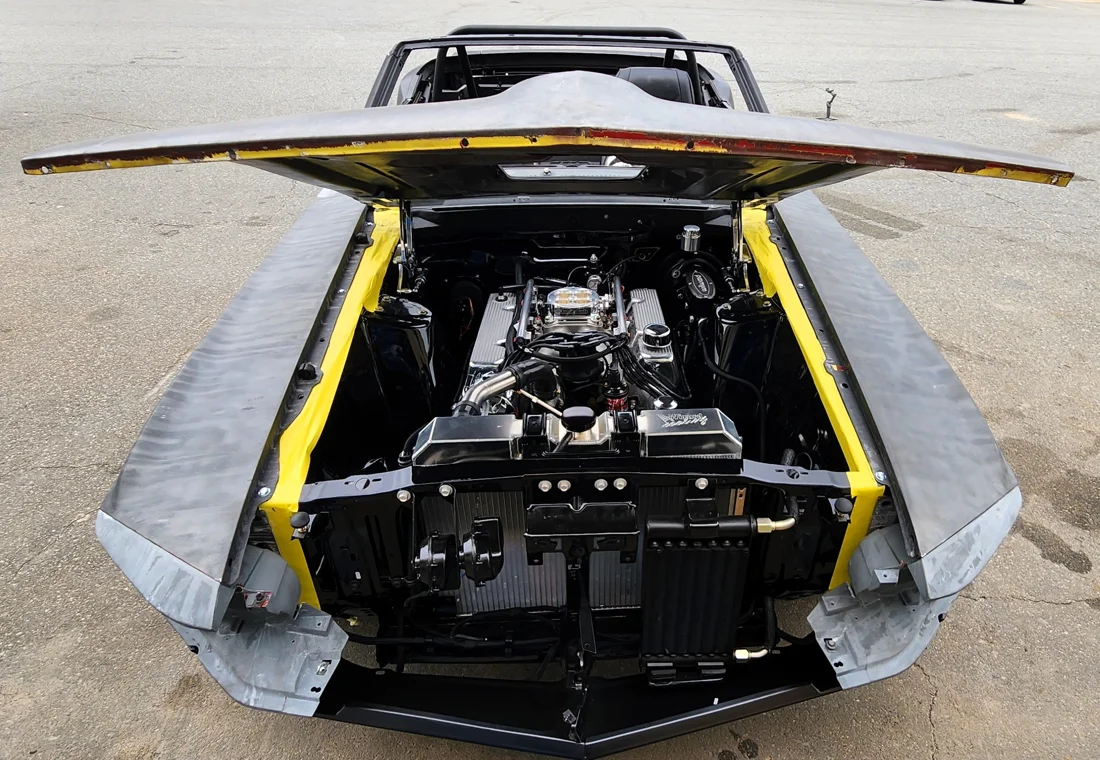
The most common problems we see usually aren’t caused by some obscure piece of cooling-system theory.
They’re much simpler.
The vehicle doesn’t have a proper expansion reservoir, or the cooling components were chosen without enough thought about how they’ll work together.
We’ve seen extremely high-level custom cars built with some of the least expensive radiator packages available. Then the owner ends up chasing cooling problems in a vehicle where virtually everything else was built to a much higher standard.
That’s why we’d encourage anyone building a performance car to think about the cooling system earlier.
Before you buy the parts, ask:
How much room does the radiator and fan package need?
What accessory drive are you using?
How far forward does the water pump sit?
Could a more compact accessory drive give you additional clearance?
Where will the engine sit in the vehicle?
What radiator and fan combination is actually designed to work together?
Those questions are much easier to answer at the beginning of a build than after the engine is installed and you’re trying to fit a cooling system into whatever space is left.
A high-performance cooling system isn’t about buying the component with the biggest number on the box.
It’s about choosing proven components that complement one another and planning enough room for them to do their jobs.
At Prestige Motorsports, that’s what guides the components we use and why we use them.